Driving in Orange County means dealing with intense sunlight that can turn your car into an oven while you are parked at the Irvine Spectrum or commuting on the 405. Many drivers find themselves stuck between choosing a tint that looks good and one that actually keeps the heat out. The 3M Ceramic IR vs 3M Crystalline debate is the most common conversation we have at OC Tint Solutions because both films are top-tier but use completely different science to protect you. If you want to stop the burning sensation on your skin during your midday drive without necessarily making your windows pitch black, understanding these two options is the first step toward a much cooler ride.
3M Window Tint: A Leader in Automotive Films
3M is a brand known for its innovative window tinting solutions. With a reputation for quality, durability, and advanced technology, 3M window films provide significant benefits, from improving comfort to protecting your vehicle’s interior. 3M offers a wide range of tinting options, with Ceramic IR and Crystalline films being two of their most popular choices for automotive applications. 3M window films are designed using advanced technology that combines multiple layers of film, allowing them to reject heat, block harmful UV rays, and offer privacy without compromising visibility. One of the key features that set 3M apart is its ceramic technology. 3M Ceramic IR films use ceramic particles to block infrared heat, while 3M Crystalline films employ multi-layered nanotechnology for superior heat and UV rejection.
3M Crystalline Window Film: What Makes It Unique?
3M Crystalline window film is one of the most advanced options available on the market today. It is known for its ability to provide superior heat rejection without compromising visibility. The 3M Crystalline film is designed using multi-layered technology, which allows it to provide exceptional heat rejection while maintaining the clarity of your windows. This film uses a non-metallic construction that helps it reject heat without blocking signals, making it an excellent choice for modern vehicles that rely on GPS, Bluetooth, or cellular signals.
Key Features and Benefits of 3M Crystalline
- Superior Heat Rejection: 3M Crystalline can block up to 60% of solar energy and 97% of infrared light, which helps keep your vehicle cool and comfortable.
- Clear and Transparent: One of the standout features of 3M Crystalline is its clarity. It provides exceptional visibility and doesn’t darken the windows significantly, offering a more natural look.
- UV Protection: 3M Crystalline blocks 99% of harmful UV rays, helping protect your skin from damage and preventing your car’s interior from fading.
- Glare Reduction: The film reduces glare from the sun, which improves visibility and driving comfort.
How 3M Crystalline Stands Out from Other Films
Compared to other window tints, 3M Crystalline provides a higher level of clarity and heat rejection without compromising aesthetics. While it’s more expensive than traditional tints, the combination of performance and visibility makes it a popular choice for those who want maximum protection with minimal change to their vehicle’s appearance.
3M Ceramic IR Window Film: What Sets It Apart?
If you’re looking for a tint that excels in infrared heat rejection, 3M Ceramic IR might be the better option for you. This film uses ceramic particles to block infrared light, which helps keep your vehicle cooler even in the hottest weather. 3M Ceramic IR is a non-metallic, nano-ceramic film that uses advanced technology to block infrared radiation. This film provides exceptional heat rejection while maintaining a high level of transparency, making it an ideal choice for people who want to keep their car cooler without making the windows too dark.
Key Features and Benefits of 3M Ceramic IR
- Infrared Heat Rejection: 3M Ceramic IR can block up to 95% of infrared heat, which is a significant improvement over traditional tints. This makes it perfect for those living in hot climates like California.
- UV Protection: Like 3M Crystalline, 3M Ceramic IR provides excellent protection against UV rays, blocking up to 99% of harmful rays.
- Comfort and Privacy: The film helps keep the cabin cooler, making it more comfortable to drive, especially in the summer. Additionally, it provides better privacy due to its darker appearance compared to the Crystalline film.
- Signal-Friendly: Unlike some metallic films, 3M Ceramic IR does not interfere with cellular, GPS, or radio signals, making it suitable for modern vehicles.
Why Ceramic IR is Ideal for UV and Heat Protection
3M Ceramic IR stands out due to its exceptional heat rejection. Unlike 3M Crystalline, which primarily focuses on visible light and infrared light, 3M Ceramic IR is specifically designed to reject infrared heat, which is one of the main contributors to discomfort in a vehicle. This makes it perfect for those seeking maximum cooling performance.
Main Differences Between 3M Crystalline and 3M Ceramic IR Window Films
When choosing between 3M Crystalline and 3M Ceramic IR, it’s important to understand how each film performs in different aspects. Here’s a comparison table to help highlight their differences:
| Feature | 3M Crystalline | 3M Ceramic IR |
| Heat Rejection | Blocks up to 60% solar energy, 97% infrared | Blocks up to 95% infrared heat |
| UV Protection | 99% UV protection | 99% UV protection |
| Clarity | Excellent clarity, doesn’t darken windows significantly | Slightly darker than Crystalline, maintains good clarity |
| Glare Reduction | Reduces glare, ideal for clear visibility | Reduces glare, ideal for privacy |
| Infrared Rejection | Moderate infrared heat rejection | Superior infrared heat rejection |
| Signal Interference | No interference with signals | No interference with signals |
| Price | Higher due to advanced multi-layer technology | Slightly more affordable |
| Best For | Those who want superior clarity and comfort | Those who prioritize infrared heat rejection and privacy |
Performance Showdown: Heat Rejection and Solar Specs
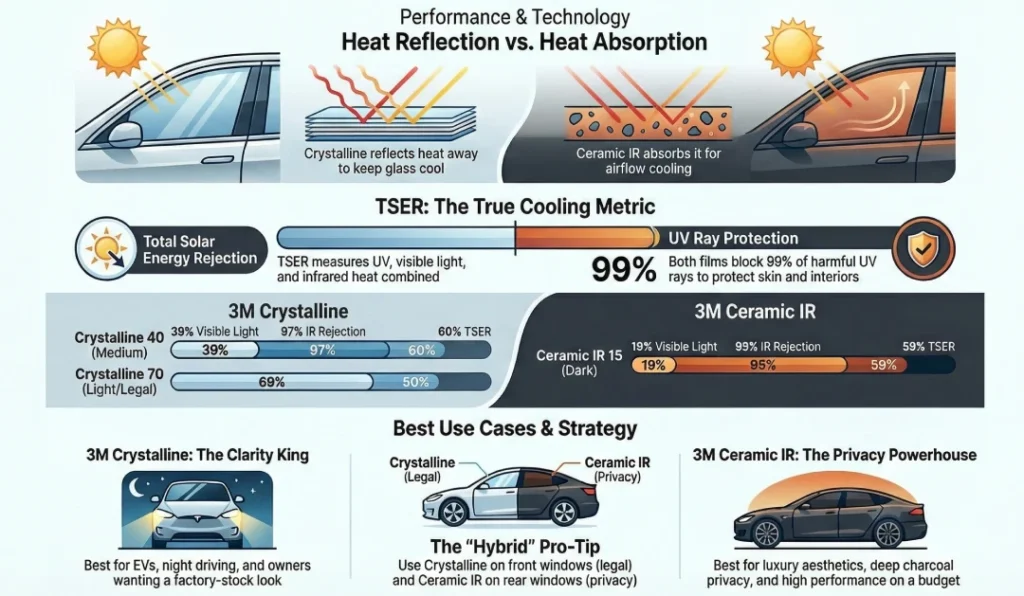
To find the right fit for your vehicle, you have to look at the numbers that define comfort. Total Solar Energy Rejection (TSER) is the most accurate way to measure how much heat a film blocks because it accounts for UV rays, visible light, and infrared heat combined. While many shops only talk about infrared, TSER tells the whole story of how cool your car will actually stay during a California summer. If you aren’t sure if 3M is the only premium brand to consider, see how it stacks up against other industry leaders in our LLumar vs XPEL comparison to see how different manufacturing technologies impact heat rejection.
3M Crystalline vs. 3M Ceramic IR Performance Data
| 3M Film Series | VLT % (Darkness) | IR Rejection (IRR) | Total Solar Energy Rejected (TSER) |
| 3M Ceramic IR 15 | 19% | 95% | 59% |
| 3M Ceramic IR 70 | 78% | 78% | 47% |
| 3M Crystalline 40 | 39% | 97% | 60% |
| 3M Crystalline 70 | 69% | 97% | 50% |
| 3M Crystalline 90 | 86% | 90% | 34% |
Total Solar Energy Rejection (TSER) Explained
Many people are surprised to see that a light version of 3M Crystalline can block more heat than a much darker version of a standard film. TSER is the metric that proves this. For example, Crystalline 40 rejects 60% of the total solar energy hitting your window. To get that same level of protection with the Ceramic IR line, you would have to go much darker. This makes Crystalline the perfect choice for the front windows of your car, where you need to keep things light to stay safe and legal while still stopping the heat.
The Motion Factor: Heat Absorption vs. Heat Reflection
There is a practical difference in how these films feel when your car is sitting still versus when you are driving. Since Ceramic IR absorbs heat, the glass itself can get quite hot if the car is parked in a sunny lot in Orange County for several hours. Once you start driving, the airflow helps cool the glass down. Crystalline, however, reflects that energy away from the car. This means the glass stays cooler even when you aren’t moving, which helps your interior stay at a lower temperature from the moment you open the door.
Aesthetics and Visibility: Hue, Clarity, and Shade Range
Beyond performance, the way your car looks is a major factor in your decision. In a place like Orange County, where car culture is a way of life, the finish of your window film matters. While both 3M Ceramic IR and Crystalline offer high clarity, they have distinct visual personalities. Ceramic IR provides that classic, sleek appearance that many people associate with luxury vehicles, while Crystalline is often chosen for its ability to protect a car without changing its factory look. Regardless of the film you choose, the lifespan of the product depends on the application. Avoid common pitfalls by choosing professional car window tinting over DIY kits tha can bubble, peel, and void your 3M warranty.
The Color Palette: Blue/Charcoal (Ceramic) vs. Subtle Brown (Crystalline)
When you look through the glass, you will notice a difference in the color tone. 3M Ceramic IR leans into a neutral charcoal or cool blue hue, which blends perfectly with the factory tint found on many modern SUVs and sedans. On the other hand, 3M Crystalline has a very slight, warm brownish or amber undertone due to its 200 layers of optical film. While this tint is nearly invisible at higher VLT levels, the subtle hue is designed to enhance contrast and clarity, much like a high-end pair of driving glasses.
Available VLT Options for Every Driver
The Ceramic IR series offers a wider range of dark shades, including a 5% limo tint for maximum privacy in the back seats. Crystalline is more focused on the lighter end of the spectrum. It is available in shades like CR40, CR70, and CR90. Because Crystalline 70 and 90 are so light, they are the preferred choice for drivers who want to keep their car looking stock or for those who struggle with visibility at night.
Glare Reduction and Nighttime Clarity
Driving on the PCH during sunset can be difficult due to the reflection off the water. Both films help reduce glare, but they do it differently. Ceramic IR uses its darkness to cut down on light intensity. Crystalline, however, uses its optical layers to reduce up to 77% of glare even in its lighter shades. This is a huge benefit for nighttime safety; you get the glare reduction from oncoming headlights without the dangerously dim view that comes with standard dark films.
The Orange County Legal Guide: Tinting in California
California has some of the strictest window tint laws in the country, and Orange County law enforcement is known for checking compliance. The law focuses on Visible Light Transmission (VLT). If your film is too dark, you risk a fix-it ticket and a fine. Understanding how to balance your desire for heat rejection with these legal limits is where choosing between Ceramic IR and Crystalline becomes a strategic move.
Compliance for Front Windows (The 70% Rule)
In California, the front side windows (driver and passenger) must allow at least 70% of light to pass through. This is where 3M Crystalline 70 shines. Because it is so light, it often meets the legal requirement while still blocking more heat than a much darker, illegal ceramic tint. Most Ceramic IR films in the dark shades (like 15% or 25%) are strictly for the rear windows only. If you want protection on your front doors, Crystalline is usually the only way to stay truly legal.
Privacy Needs vs. Legal Visibility
Many of our clients choose a hybrid approach to stay safe and legal. They use 3M Ceramic IR 5% or 15% on the rear windows for total privacy and to keep the kids or groceries cool in the back. Then, they switch to 3M Crystalline 70 on the front two windows. This gives the car a uniform, high-end look while ensuring the driver has a clear, legal view of the side mirrors and the road ahead, especially in low-light conditions.
Price and Long-Term Value (2026 Market Data)
Quality window film is an investment in your vehicle’s longevity and your personal comfort. While the initial cost might seem high compared to budget shops, the long-term value of 3M products is unmatched. In 2026, we see a clear price gap between these two series, but that gap is justified by the specialized manufacturing processes 3M uses for each.
Initial Investment: The 20-30% Price Premium
On average, a full installation of 3M Crystalline will cost about 20% to 30% more than 3M Ceramic IR. This is because Crystalline is significantly harder to manufacture and requires a higher level of skill to install. The multi-layer technology is delicate and takes more time for our technicians to heat-shrink and fit to your glass perfectly. Ceramic IR is more affordable and offers a faster installation time, making it the better choice for those who want great performance on a tighter budget.
Durability and the 3M Limited Lifetime Warranty
One of the best reasons to choose a 3M film from an authorized dealer like OC Tint Solutions is the peace of mind. Both Ceramic IR and Crystalline come with a limited lifetime warranty that is backed by 3M nationwide. This covers you against bubbling, peeling, blistering, or the film turning purple. Because these films are metal-free, they will never corrode or interfere with your vehicle’s electronics, ensuring that your investment looks and performs like new for as long as you own the car. Whether you prioritize the sleek, dark look of Ceramic IR or the high-tech, clear protection of Crystalline, OC Tint Solutions is Orange County’s premier destination for high-performance automotive protection.
Specialized Use Cases: Which Should You Choose?
Selecting between 3M Ceramic IR and Crystalline often comes down to the specific vehicle you drive and your primary goal. While both films are high-performing, their unique engineering makes them better suited for different scenarios. For some, it is about the sleek aesthetic of a dark car, while for others, it is about maintaining a cool cabin without changing the look of a luxury vehicle. Understanding these niche benefits helps you get the most value out of your investment at OC Tint Solutions.
Best for Electric Vehicles (EVs)
If you drive a Tesla, Rivian, or Lucid in Orange County, heat management is a performance requirement. EVs have massive glass surfaces that act like greenhouses, forcing the battery to work overtime to run the air conditioning. We recommend 3M Crystalline for EV owners because its heat-reflective technology is superior at keeping the car cool even when it is parked in a sunny Anaheim lot. By reducing the load on your HVAC system, you can actually see a noticeable improvement in your driving range and battery health over time.
Best for Privacy and Aesthetics
For many drivers, the goal is to give their car a bold, aggressive look while hiding valuables from prying eyes. 3M Ceramic IR is the clear winner in this category. It offers deep, rich charcoal shades that provide excellent privacy for rear passengers and cargo. If you want that classic blacked-out look that remains color-stable and won’t turn purple, Ceramic IR gives you the best balance of style and heat protection for your dollar.
Best for Night Driving and Older Eyes
Nighttime visibility is a common concern, especially as we age. Standard dark tints can make it difficult to see pedestrians or obstacles in dimly lit neighborhoods. 3M Crystalline 70 or 90 is the ideal solution here. It provides the heat rejection of a dark tint with the optical clarity of a clear window. This ensures you have maximum visibility during rain or late-night drives through Costa Mesa while still enjoying total UV protection during the day.
Frequently Asked Questions
Is 3M Crystalline worth the extra cost over Ceramic IR?
Yes, if you prioritize heat reflection over heat absorption. Crystalline uses over 200 layers of technology to keep the glass itself cooler, making it the best choice for maximum comfort and high-end vehicles.
Does 3M Ceramic IR interfere with 5G or GPS signals?
No. Both 3M Ceramic IR and Crystalline are 100% metal-free. This means you will have zero issues with your cell signal, GPS, or satellite radio, which is vital for modern, tech-heavy cars.\
Can you mix and match Ceramic IR and Crystalline on the same car?
Absolutely. This is a popular pro-tip at our shop. Many clients use Crystalline on the windshield and front windows for legal heat protection and Ceramic IR on the back windows for privacy and cost savings.
Can I get both films installed on my home and vehicle?
Yes, both 3M Crystalline and 3M Ceramic IR can be applied to both homes and vehicles, providing comfort and protection across different environments.
How long will my 3M window tint last?
Both films come with a lifetime warranty, and with proper care, they can last for many years without fading or peeling.
Verdict: The Final Recommendation from OC Tint Solutions
The best film is the one that fits your lifestyle and budget. If you are looking for the absolute pinnacle of window film technology and want your car to stay as cool as possible without necessarily making it dark, 3M Crystalline is the undisputed champion. However, if you want a high-performance ceramic tint that looks great, provides excellent privacy, and offers a better price-to-performance ratio, 3M Ceramic IR is an outstanding choice that will serve you well for years. At OC Tint Solutions, we take pride in helping our Orange County neighbors find the perfect match for their vehicles. Whether you are in Anaheim or Costa Mesa, our certified installers are ready to help you transform your driving experience.