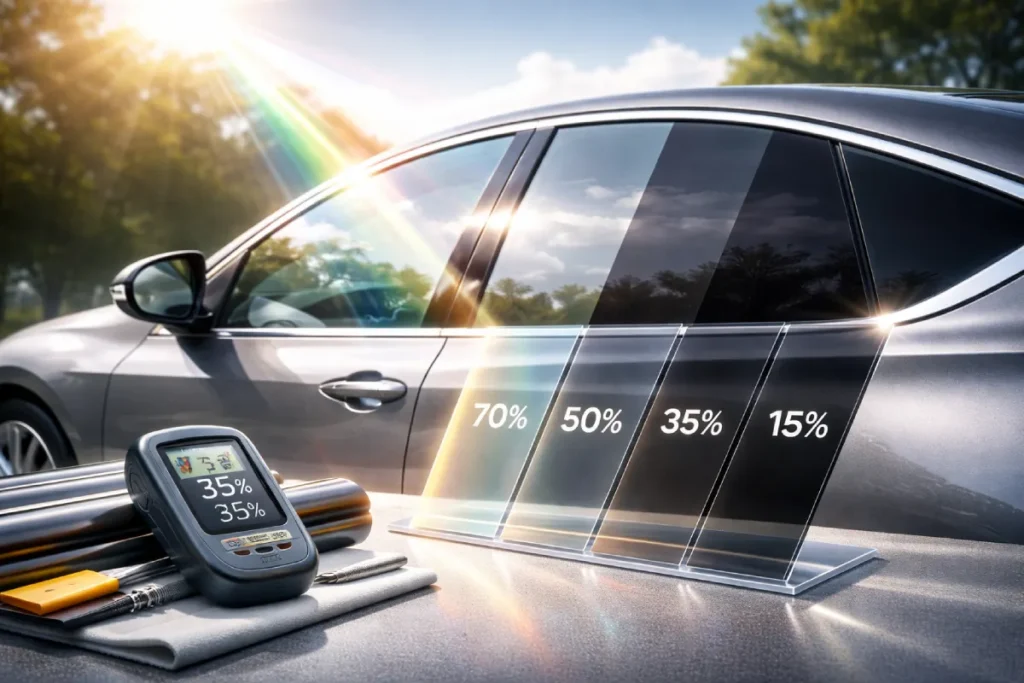
When you hear someone talk about 20% tint or limo tint, they are referring to Visible Light Transmission, or VLT. Put simply, VLT is the percentage of visible light that can travel through a material, like a window or a sunglass lens, and reach your eyes. A higher VLT percentage means more light gets through, making the glass appear clearer. A lower VLT percentage means more light is blocked, making the glass look darker. For Orange County drivers, understanding VLT is the difference between getting a sleek, heat-rejecting upgrade and getting a fix-it ticket from a local officer on the 55 freeway.
The Science of VLT: How Light Interacts with Glass and Film
VLT focuses specifically on the visible part of the solar spectrum, which ranges from roughly 380 to 760 nanometers. This is the light that allows us to see colors and shapes. It is important to note that VLT does not measure ultraviolet (UV) rays or infrared (IR) heat. This is why a film can be nearly clear (90% VLT) but still block almost all the heat and sun damage. At OC Tint Solutions, we use this science to help our clients choose a film that provides the look they want without sacrificing the protection they need.
Measuring the Spectrum: What Your Eyes Actually See
The human eye is highly sensitive to changes in the visible spectrum. When light hits a window treated with film, three things happen: some light is transmitted (passes through), some is reflected (bounces off), and some is absorbed (soaked up by the glass). VLT is the measurement of that first part, the transmitted light. If a window has a VLT of 35%, it means 35% of the light is passing through to the interior, while the remaining 65% is being reflected or absorbed to provide shade and privacy.
Transmission vs. Reflection vs. Absorption
While VLT tells you how dark the window is, the other two factors, reflection and absorption, determine how the tint performs. High reflection gives a window a mirrored look, which is actually restricted in California for safety reasons. High absorption is common in ceramic films, where the material soaks up the heat to keep it from entering the cabin. By balancing these three factors, we can provide Anaheim residents with a window film that offers perfect visibility during a coastal sunset while still blocking the harsh afternoon glare.
The Automotive VLT Formula: Why Your Tint Might Be Illegal
The biggest mistake people make is assuming that if they buy 35% film, their car windows will register at 35% on a tint meter. This is rarely the case. Modern vehicles, especially luxury cars and SUVs common in Costa Mesa, come from the factory with a slight tint already built into the glass. This factory VLT is usually between 70% and 85%. When you apply a film on top of that glass, the two percentages multiply, resulting in a net VLT that is much darker than the film alone.
Calculating Net VLT: The Pro Method
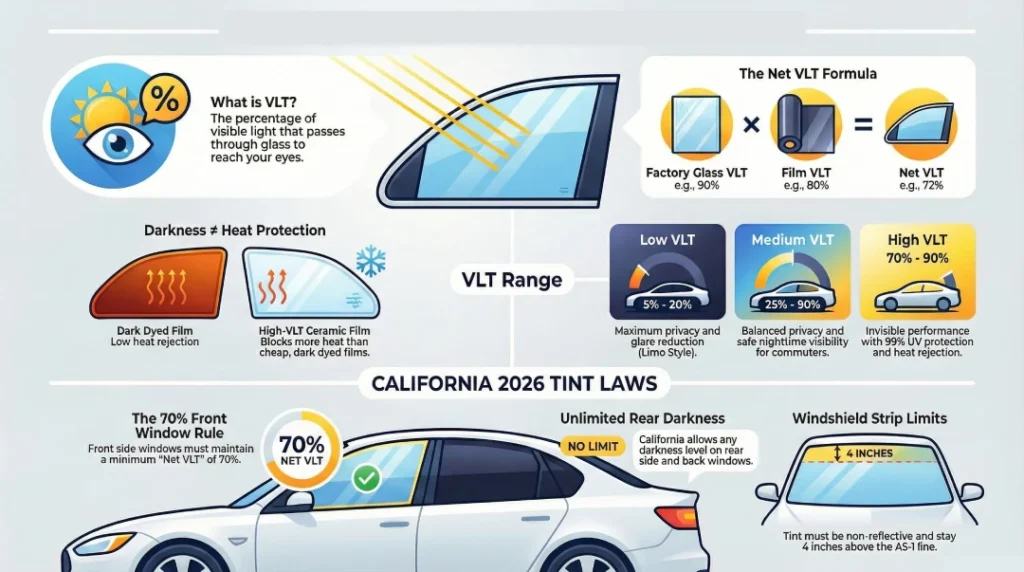
To find out how dark your windows will truly be, you have to use a simple math formula. You take the VLT of your factory glass and multiply it by the VLT of the film you want to add. For example, if your factory glass is 80% and you add a 35% film, your final reading will be approximately 28% ($0.80 \times 0.35 = 0.28$). At OC Tint Solutions, we always measure your windows before we start. This ensures that when we tell you a film is legal, it stays legal once the math is done and the film is cured.
The Factory Tint Myth
Many owners of SUVs and trucks believe their rear windows are tinted from the factory. In reality, most factory privacy glass is simply dyed glass that offers shade but very little heat or UV protection. Because this glass often has a very low VLT (around 20%), adding even a light film can make the windows nearly opaque. We specialize in matching these factory rear windows with high-performance ceramic films on the front doors to create a uniform look that satisfies both your aesthetic goals and California’s strict VLT requirements. Choosing a VLT level is often a trade-off between privacy and night vision. For a deeper look at how darkness affects your safety after the sun goes down, our guide on car tinting and heat reduction can help you find the perfect balance for your commute.
VLT Categories: From Limo Tint to Clear Protection
Finding the right VLT level is about more than just picking a color; it is about matching the film to your specific needs. At OC Tint Solutions, we group films into four main categories to help our Anaheim and Costa Mesa clients choose the best fit. Whether you are looking for the total privacy of a blacked-out look or the invisible heat protection of a clear film, understanding these categories ensures you get the performance you expect without any surprises.
Low VLT (5% – 20%): Maximum Privacy and Limo Style
Films in the 5% to 20% range are what most people call limo tint. These are the darkest options available and are primarily used for rear windows and cargo areas. They block nearly all visibility from the outside, making them excellent for families who want to keep kids cool or for business owners who need to hide expensive tools in their trucks. Because they transmit so little light, these shades offer the highest level of glare reduction, though they can make it difficult to see out of the vehicle at night in poorly lit areas. You don’t need a low VLT to block heat. Our ceramic window tint service explains how nano-ceramic particles block 99% of UV rays even at high, clear VLT percentages.
Medium VLT (25% – 50%): The Balanced Sweet Spot
The 25% to 50% range is our most popular choice for sedans and sporty cars. This level provides a noticeable tinted look that enhances the vehicle’s profile while still allowing enough light through for safe nighttime driving. It offers a great balance of privacy and visibility. In the bright California sun, a 35% tint can significantly cut down on eye strain without making the interior feel like a cave, which is why so many daily commuters on the 405 choose this middle-ground option.
High VLT (70% – 90%): Invisible Performance
High VLT films are nearly clear to the naked eye, but don’t let their appearance fool you. When using premium nano-ceramic or 3M Crystalline technology, these light films can block more heat than some of the darkest cheap tints. These are designed specifically for windshields and front side windows. They allow you to maintain a factory look and excellent night vision while still enjoying a 99% reduction in UV rays and a massive drop in cabin temperature.
California Window Tint Laws: 2026 Update for Orange County
Staying legal is a top priority for any vehicle owner in Orange County. The California Vehicle Code is very specific about which windows can be tinted and how dark they are allowed to be. If you are caught with tint that is too dark on the wrong windows, you may face a fix-it ticket, which requires you to remove the film and pay a fine. Our team stays up to date on these laws to ensure every car that leaves our shop in Anaheim or Costa Mesa is compliant with the latest 2026 standards. Because VLT requirements vary wildly by window location, we offer a specialized window tint shades service to help you mix and match percentages, keeping your rear windows private and your front windows legal.
Front Side Window Requirements (The 70% Rule)
According to the latest California regulations, the front side windows (the ones next to the driver and front passenger) must have a net VLT of at least 70%. This is where the calculation becomes vital. Since most factory glass is already around 75-80% VLT, you cannot put a standard dark film on these windows. Instead, you must use a very light, high-performance film that maintains that 70% total light transmission while still blocking heat.
Rear Side and Back Window Freedom
Unlike the front of the vehicle, California law allows you to go as dark as you want on the rear side windows and the back windshield. There is no VLT limit for these areas, provided your vehicle has dual outside rearview mirrors. This is why you see many SUVs in Orange County with very dark rear glass and lighter front glass. This staggered look allows for maximum privacy for passengers and cargo while keeping the driver in full compliance with state safety laws.
The AS-1 Line and Windshield Strips
California law prohibits tinting the entire windshield unless you have a specific medical exemption. However, you are allowed to apply a strip of non-reflective tint to the top of the windshield. This strip cannot extend more than 4 inches down from the top and must stay above the AS-1 line marked on your glass. This is a great way to block the blinding brow glare from the sun without obstructing your view of traffic lights or the road ahead.
VLT vs. Heat Rejection: Why Darkness Doesn’t Always Equal Coolness
One of the most common myths we hear at OC Tint Solutions is that a window must be dark to block heat. In the past, this was somewhat true, as dark dyes were the only way to stop the sun. However, modern 2026 film technology has completely changed the game. You no longer have to sacrifice visibility or risk a ticket just to keep your car cool. Understanding the difference between shade and thermal protection is key to getting the best value for your car.
The Rise of High-VLT Nano-Ceramic Films
Thanks to nano-ceramic and multi-layer optical technology, we can now offer films that are almost clear but have incredible heat-blocking power. These films use microscopic particles to target infrared heat rather than just visible light. This means a 70% VLT ceramic film can actually outperform a 5% VLT budget dyed film in terms of cooling your interior. This is the perfect solution for Orange County drivers who want to protect their skin and their dashboard without the blacked-out look.
TSER vs. VLT: The Number You Actually Need
Total Solar Energy Rejection (TSER) is the true measurement of how much a film protects you. While VLT tells you how much light you see, TSER tells you how much total heat, including UV and Infrared, is being blocked. When choosing a tint at our Anaheim or Costa Mesa locations, we encourage you to look at the TSER rating. A high-VLT film with a high TSER is the ultimate setup for performance and legality, giving you the best of both worlds: a cool car and a clear, legal view.
Professional VLT Testing: How We Ensure You Stay Legal
One of the most valuable services we provide at OC Tint Solutions is professional VLT metering. We don’t guess how dark your windows are; we measure them with the same precision-calibrated tools used by law enforcement. This takes the stress out of the process, ensuring that when you drive away from our shop, you have the confidence that your vehicle meets all California safety standards.
How Tint Meters Work
A tint meter is a specialized handheld device that uses a light source and a sensor to calculate the exact percentage of light passing through your window. There are two main types: the horseshoe meter, which slides over the top of a rolled-down window, and the magnetic probe meter, which can test fixed glass like windshields. The device shines a beam of light at a specific frequency (usually 550 nanometers) through the glass, and the sensor on the other side measures exactly how much of that beam made it through.
Pre-Installation Metering at OC Tint Solutions
Before we apply any film to your vehicle, we perform a baseline test on your factory glass. Most factory windows are not 100% clear. By knowing your starting VLT, we can help you choose a film that, when combined with your glass, results in a legal and high-performing final product. This professional approach is why local drivers trust us to handle their luxury vehicles and daily commuters alike.
The Impact of VLT on Eye Health and Comfort
When selecting a window tint or eyewear, understanding the impact of VLT on your eye health and comfort is essential. Whether you’re driving in bright sunlight or working in a well-lit office, the amount of visible light passing through your lenses can significantly affect your visual comfort and long-term eye health.
Does VLT Affect Eye Comfort?
VLT directly impacts the amount of light entering your eyes, and this can influence how comfortable your eyes feel throughout the day. For example, in bright conditions, a lower VLT (darker tint) can reduce the amount of light hitting your eyes, making it more comfortable to see and less straining on your eyes. Conversely, a higher VLT (lighter tint) allows more light through, which is useful in low-light or indoor conditions but may cause eye strain if used in bright environments.
Here’s how VLT affects comfort:
- High VLT (60%-90%): Best for indoor environments or cloudy days, as it provides a natural, clearer view and minimal glare. However, it may not offer enough protection from bright sunlight, causing discomfort and fatigue.
- Moderate VLT (40%-60%): Suitable for variable light conditions, offering a balance between visibility and glare reduction.
- Low VLT (5%-20%): Ideal for extremely bright conditions, blocking excessive light and providing relief from glare and UV exposure, making it ideal for driving and outdoor activities.
How VLT Impacts Long-Term Eye Health
When exposed to excessive sunlight, UV radiation can cause damage to your eyes, leading to conditions like cataracts and macular degeneration. While UV protection is a separate measure from VLT, films with high UV-blocking capabilities paired with a moderate VLT can provide optimal protection. The VLT levels themselves don’t directly impact UV absorption but influence how much visible light is allowed through, reducing glare and potentially preventing squinting. Over time, using window tints or eyewear with the appropriate VLT level helps reduce eye strain, which can prevent long-term damage. It’s important to choose tinted films or lenses that offer both UV protection and the correct VLT for your lifestyle needs.
Common Questions About VLT
What does VLT stand for in window tinting?
VLT stands for Visible Light Transmission, which refers to the percentage of visible light that passes through a window film, lens, or any other transparent surface.
What is the best VLT for sunglasses?
For sunglasses, the best VLT typically falls within the 20%-40% range for sunny conditions, providing enough light reduction while maintaining clear visibility. For variable weather, 50%-60% VLT is effective in both sunny and cloudy conditions.
Can VLT be measured on all types of window tints?
Yes, VLT can be measured on all types of window tints, whether for cars, homes, or commercial properties. The VLT percentage will depend on the tint level applied to the surface.
What VLT is recommended for driving in bright sunlight?
For driving in bright sunlight, lower VLT (20%-40%) is ideal as it blocks out glare, protects from UV rays, and ensures maximum comfort while driving.
How do lens colors affect VLT?
Lens colors, such as gray, amber, or yellow, can impact the perceived VLT and light transmission. For instance, gray lenses reduce brightness without distorting colors, while yellow lenses enhance contrast in low-light environments.
Conclusion: Choosing the Right VLT for Your Needs
Understanding Visible Light Transmission (VLT) is essential when selecting the right window tint or eyewear for your vehicle or home. Whether you’re looking for UV protection, heat rejection, glare reduction, or simply want to enhance your privacy, the right VLT can make all the difference. If you’re in Orange City, California, and need help choosing the right VLT for your vehicle or home, contact Octint Solutions. We specialize in providing expert window tinting services with a variety of VLT options to meet your specific needs, ensuring comfort, privacy, and protection for your vehicle or property.Let us help you find the perfect VLT film to enhance your lifestyle, whether you’re reducing glare on the road or improving energy efficiency at home.